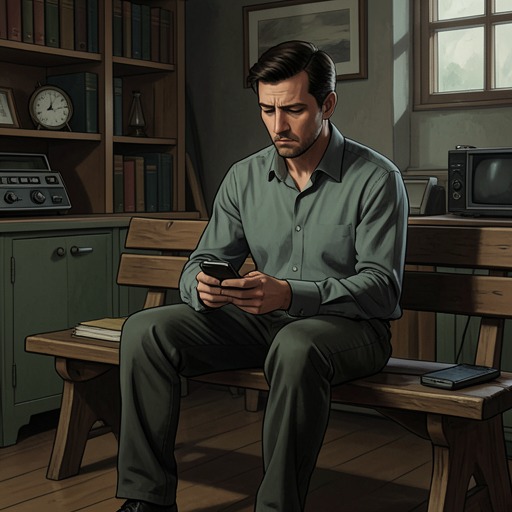
Clay Jensen—Tony
Thirteen Reasons WhyClay Jensen and Tony are connected by ordinary familiarity that becomes consequential when Clay needs a way to hear Hannah Baker’s tapes. Tony’s yellow Walkman gives Clay access to the recordings, while Tony’s eventual response to Clay’s concealed borrowing turns a practical favor into an act of trust. Their relationship does not depend on intimate friendship; its significance lies in what Tony makes possible, and in the unhurried kindness with which he allows Clay to continue.
Familiarity and Practical Trust
Clay knows where Tony lives because they have worked together on a couple of assignments. He does not describe Tony as a close friend, but he knows that Tony owns an old Walkman that plays tapes and expects he will be allowed to borrow it. That modest confidence is enough to give Clay a plan: he can take some of the recordings with him and listen while walking through Hannah’s old neighborhood, only a short distance from Tony’s home.
The need is more than technical. Clay cannot listen comfortably at home and wants somewhere private, with room to breathe. The recordings arrive as seven tapes marked with dark-blue numbers, each side numbered in sequence; the final tape has a number on only one side. Their arrangement makes the Walkman an indispensable means of access to a story intended to be heard in order. Tony’s possession of an outdated player places him in the chain through a commonplace object rather than through any stated knowledge of the tapes’ contents.
The Walkman and Clay’s Concealment
When Clay reaches Tony’s house, Tony is working on his old Mustang with his father. The car’s engine is open, Tony holds a flashlight, and his father is tightening something with a wrench. Clay asks whether the car has broken down or whether the repair is for fun. Tony turns at the sound of him and drops the flashlight into the engine, an awkward interruption before Clay can ask for what he came to borrow.
Clay thinks through the explanation he could give: the tapes were sent to him by Hannah, who died by suicide, and he wants to know what part he played in her story. He says none of this. Instead, he looks into the car and spots the Walkman on the floor behind the passenger seat, its headphone cord wrapped around it. When Tony and his father exchange tools, Clay grabs the player, slips it into the open middle pocket of his backpack, and zips the pocket shut. The theft is impulsive and secretive, not a negotiated loan; the distinction matters because Clay has to carry both the recordings and the knowledge that he has taken Tony’s property without permission.
The Walkman makes the tapes’ ordered structure physically usable. Hannah’s instructions require the listener to hear all thirteen sides, rewind them, return them to the box, and pass them to the next person. She also says that copies exist and will be released publicly if the package fails to reach everyone in the chain. Later, Clay identifies his own place in that sequence by taking out the fifth tape and seeing the dark-blue number nine: he is listener number nine. The numbered sides and the player therefore do more than convey sound; they organize who hears Hannah’s account and when.
Discovery and Reassurance
At a later point, Tony finds Clay listening with the yellow headphones around his neck and the Walkman connected to a tape deck. Clay explains that he saw it in Tony’s car while helping him and thinks he asked to borrow it. He recognizes that this is a lie. Tony, however, says he is sorry and suggests that he may have forgotten Clay’s request because he gets frustrated with his father. He does not press Clay for an explanation of what he is hearing.
Tony tells Clay to return the player when he is done and adds that he can keep it as long as he needs. He places a hand on Clay’s shoulder, then moves away to sit in an empty booth with a menu. The action is deliberately low-key: Tony grants time and privacy rather than demanding disclosure. His permission retrospectively softens the secrecy of the initial taking, though it does not erase the fact that Clay had concealed his reason for needing the device.
A Quiet Support Within the Tape Chain
Tony’s role is defined by the contrast between Clay’s inward alarm and Tony’s practical generosity. Clay worries about what Tony might know and whether he is implicated in the tapes; Tony’s response, as shown in their exchange, is to let him listen without rushing him. The Walkman also carries a literal trace of that support: its cord leads from the headphones Clay wears to the tape deck, making the private act of listening visible even while the subject of the tapes remains unspoken between them.
The relation’s importance is therefore not that Tony explains Hannah’s story or resolves Clay’s uncertainty. He supplies a means of hearing it, then allows Clay the time he asks for without forcing an account of himself. As the cassette reaches the end of its spool and clicks over to continue, the recorded voice and its quiet underlying hiss persist; Tony’s permission has helped Clay remain with the sequence, one side and one revelation at a time. The friendship is expressed less through declarations than through an old player lent without a deadline.